
How many grafts do I need for a hair transplant?
Published Content: Swiss Hair Life editorial team
Medically reviewed by Dr. Sabrina Tahery (Medical Lead Oftringen) and Dr. Moustafa Kassar (Medical Lead Zurich) · Medically updated
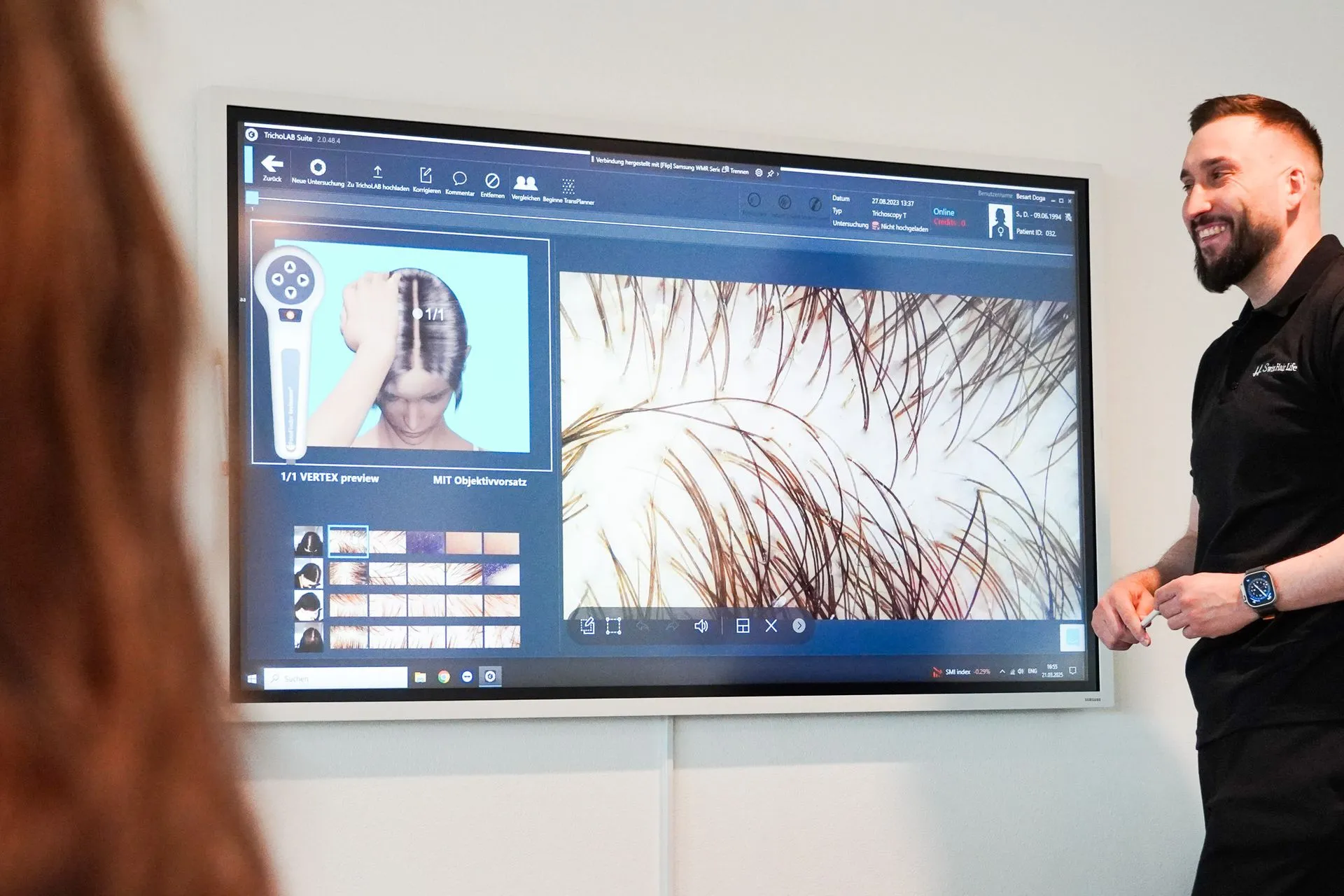
How many grafts you need does not depend only on the bald area. Hair structure, the density you want, the donor area and future hair loss also play an important role.
Short answer: The number of grafts you need is individual. Two people with bald areas of a similar size can need a different number, because hair thickness, hair density, hair structure, donor reserve, the desired hairline and long-term planning all play a role, among other things. A serious assessment therefore always takes the donor area into account, not just the area to be treated.
Our graft calculator gives you an initial, non-binding estimate. It does not replace a medical assessment.
Key points at a glance
- A graft is a follicular unit, a natural group of hairs, and usually contains one to four hairs.
- How many grafts you need does not depend only on the area, but also on hair structure and existing density.
- The donor area at the back of the head is limited and determines how many grafts are reasonably available.
- More grafts do not automatically mean a better result.
- Long-term planning matters more than taking as many grafts as possible.
- An online calculator only gives an initial guide. We set the exact number after the hair analysis.
Contents
- What is a graft?
- What does the number of grafts depend on?
- Guide values by area
- Graft calculator
- Why more grafts are not automatically better
- The donor area
- Real cases from our practice
- Prices at Swiss Hair Life
- How we determine your number of grafts
- Frequently asked questions
What is a graft?
A graft is a follicular unit, a naturally occurring group of hair roots in the scalp. A graft can contain one hair or several hairs. Scalp hair grows in such groups of usually one to four hairs (Headington 1984). In a modern hair transplant, exactly these natural units are taken and transplanted as grafts (Bernstein and Rassman 1997).
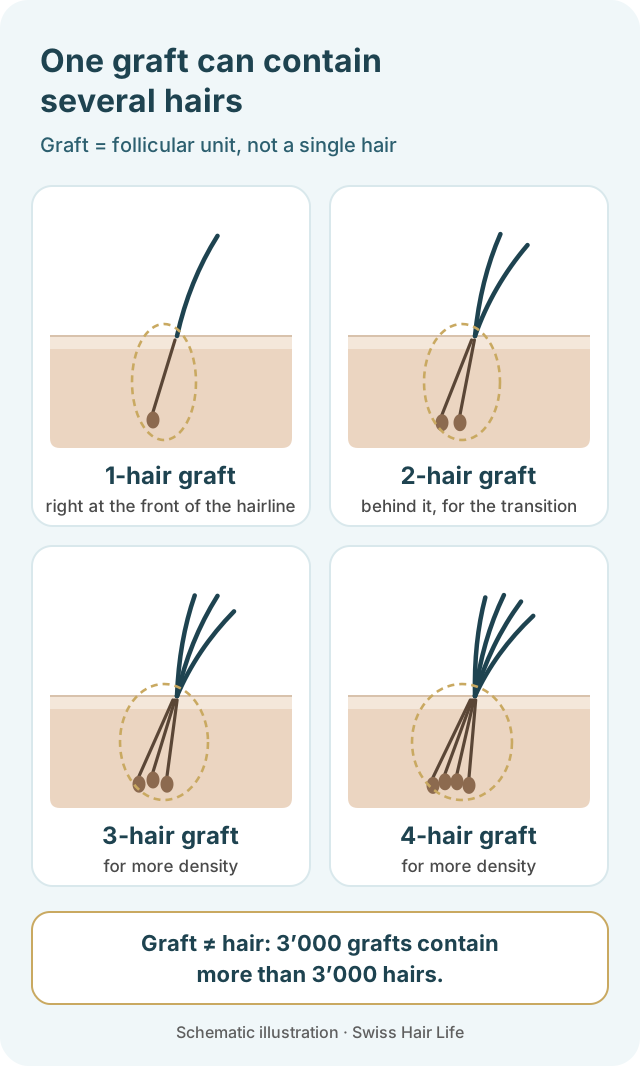
Right at the front of the hairline we place 1-hair grafts to create a soft transition. Behind them, grafts with several hairs provide density.
How many hairs are 3’000 grafts? This cannot be converted one to one, because the way grafts with one, two or more hairs are distributed varies from person to person (Jimenez and Ruifernández 1999). A worked example with an assumed value: if 3’000 grafts contained two hairs on average, that would be around 6’000 hairs. This is not an average value for our patients. How many hairs your grafts actually contain is something we see when we examine the donor area with a trichoscope.
What does the number of grafts depend on?
The area is only the starting point. These factors determine how many grafts are needed for a natural result and how many are reasonably available:
- Size of the area: The larger the area, the more grafts are needed.
- Existing hair density: If your own hair still grows in the area, fewer grafts are needed for a dense look.
- Desired density: We discuss openly which density is realistic with your donor area.
- Hair thickness, waves and hair colour: Thick, wavy or curly hair covers more of the scalp. A low contrast between hair colour and skin colour also makes hair look denser.
- Hairs per graft: If your grafts contain more hairs on average, the same number of grafts creates more density.
- Donor area: Density, hair thickness and the area at the back of the head determine how many grafts are available.
- Age and future hair loss: In many people, hereditary hair loss continues to progress over the years (Norwood 1975). The result should still look balanced then. Why your own hair next to the transplanted hair can keep thinning is explained in Can transplanted hair fall out again?
- Desired hairline: The lower and wider the new hairline, the larger the area.
- Previous hair transplants: After a previous harvest, the supply is smaller. Before a second treatment, we therefore reassess the donor area.
Graft guide values by area
The following values are guide ranges only. An exact number of grafts can only be determined after assessing the donor area and the area to be treated.
| Area | Possible graft range | What it depends on |
|---|---|---|
| Mild receding temples | up to approx. 1’500 | Depth and desired hairline |
| Pronounced receding temples | approx. 1’500–2’800 | Area and density |
| Hairline / front | up to approx. 1’500, high forehead up to 2’800 | Width, height and density |
| Front and receding temples | up to approx. 2’800 | Area and existing hair |
| Top of the scalp | approx. 1’500–3’800 | Extent of thinning |
| Crown | up to approx. 1’500, large crown up to 2’800 | Diameter and existing hair |
| Front and top of the scalp | approx. 2’800–3’800, more for a large area | Total area |
| Advanced hair loss | approx. 3’800–6’000 in two sessions | Donor reserve and long-term planning |
What do 1’500, 3’000 or 5’000 grafts mean?
| Graft range | Typical guide |
|---|---|
| up to approx. 1’500 | smaller areas such as mild receding temples or a smaller crown |
| approx. 1’500–2’800 | larger areas at the front and temples |
| approx. 2’800–3’800 | larger areas such as the front and top of the scalp |
| approx. 3’800–6’000 | very large areas, split into two sessions at Swiss Hair Life |
These values are guides. The number that actually makes sense depends in particular on the donor area, hair structure and long-term planning.
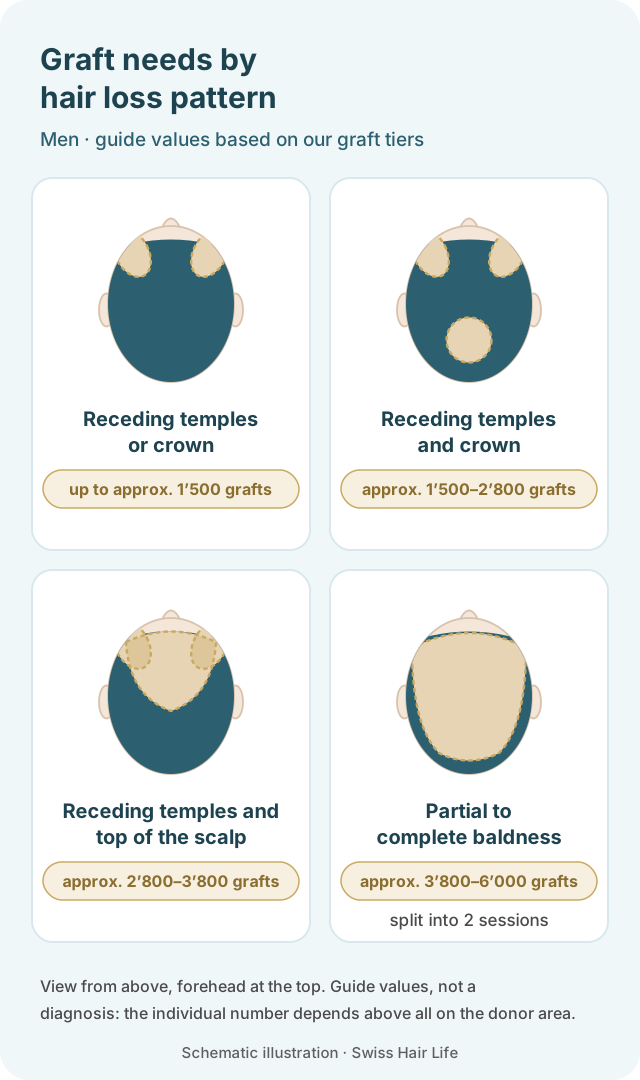
In men, the Norwood-Hamilton scale describes how far hereditary hair loss has progressed (Norwood 1975). However, a stage on the scale does not correspond to a fixed number of grafts.
Grafts in our documented cases
How much the number can vary within the same area is shown by treatments at Swiss Hair Life whose results can be seen on the hair transplant page:
| Treated area | Grafts |
|---|---|
| Hairline and receding temples | 1’500 · 1’500 · 2’000 · 2’800 |
| Receding temples | 2’400 |
| Crown | 2’200 |
| Top of the scalp | 2’800 · 3’500 |
| Front and top of the scalp | 2’500 · 4’250 |
| Receding temples, top of the scalp and crown | 2’800 |
| Women: thinning hair | 800 · 1’000 |
How many grafts do you need for receding temples?
For mild receding temples, up to around 1’500 grafts is often enough. For deep temples, or if the hairline is also to be lowered, it is more likely to be 1’500 to 2’800 grafts. What matters:
- the depth and width of the temples,
- the desired hairline,
- the existing hair at the front,
- your hair thickness,
- whether the front could recede further in future.
How many grafts does a new hairline need?
For a new hairline, up to around 1’500 grafts is often enough, or up to around 2’800 with a high forehead. Besides the area, these also count:
- the height, meaning how low the new hairline should sit,
- the width and shape of the temples,
- your age and the hair loss to be expected,
- your facial proportions,
- the existing hair behind it.
Right at the front we place single-hair grafts, at the right angle and in the natural direction of growth, slightly irregular rather than with a straight edge. A hairline planned too low can look unnatural later. That is why it should also suit your age, facial proportions and any further hair loss in the long term. More on this on the page hair transplant: the hairline.
Why does the crown need its own planning?
For the crown, up to around 1’500 grafts is often enough, or up to around 2’800 for a large crown. It differs from the front:
- The area is round and grows quickly with its diameter.
- At the whorl, the hair grows in a spiral. The grafts have to follow this direction.
- At the whorl, the hair parts in different directions, which is why the scalp shows through more easily here.
- As hair loss progresses, the crown can keep growing. We plan it so that enough reserve remains for the front and top of the scalp.
Number of grafts for women
In women, hair loss often follows a different course: the hairline is often preserved, and the hair becomes thinner along the parting and on the top of the scalp (Ludwig 1977). With a high hairline, a receding hairline or localised thinning patches, a hair transplant can make sense if the donor area is stable. We assess diffuse hair loss all over the head separately, because the donor area is often affected too. Beforehand, we clarify possible causes of hair loss and also discuss treatments without surgery such as PRP hair treatment (ISHRS). An example is shown in case 3.
How many grafts might you need?
Answer three short questions. You will immediately see a non-binding range, without entering any contact details.
Graft calculator
The calculator needs JavaScript. You will also find the guide values in the table above. You can get a personal assessment free of charge with the hair analysis.
Why more grafts are not automatically better
A high number of grafts does not automatically mean a more natural result, higher visible density, a better hairline or better results in the long term. What counts for the result is where and how the grafts are placed: at the right angle, in the natural direction of growth, with the right number of hairs per graft and in a distribution that suits your face.
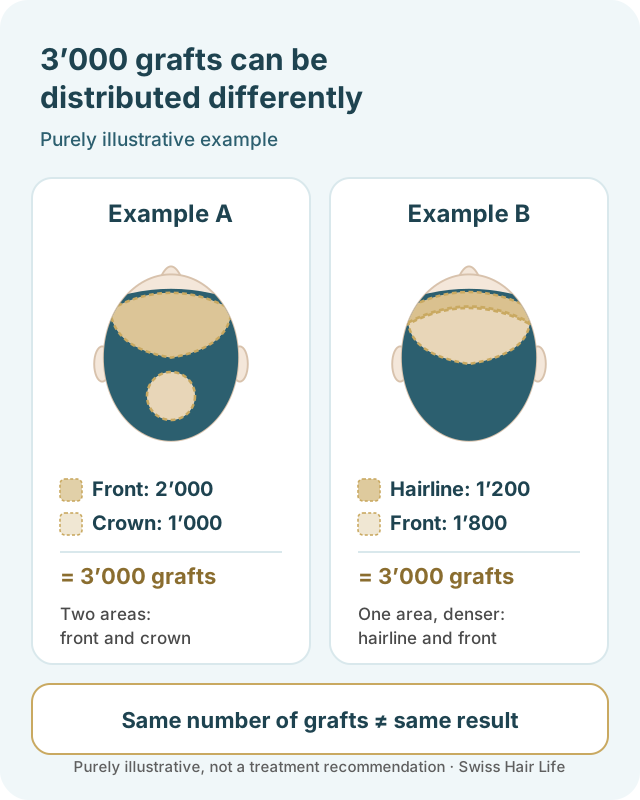
In example A, 3’000 grafts are spread over the front and crown; in example B, they are concentrated on the hairline and front, which therefore looks denser. The same number of grafts does not mean the same result.
Too many harvests can put unnecessary strain on the donor area and use up reserves that are missing later if hair loss continues. That is why at Swiss Hair Life we do not plan the largest possible number, but the number needed for a natural result that stays right in the long term. What else matters when comparing offers with very high graft numbers is covered in our comparison Hair transplant in Switzerland vs. Turkey.
It is not only about how many grafts you need – but how many can sensibly be taken
The donor area lies at the back and sides of the head. The hair follicles there are usually much less susceptible to hereditary hair loss than those on the forehead and top of the head (Orentreich 1959). This supply is limited: each graft can only be transplanted once.
How many grafts can sensibly be taken depends on the density, area and hair thickness of the donor area, on the distribution of grafts with one, two or more hairs, on previous harvests and on the reserve that should remain for later. We examine the donor area during the consultation with a trichoscope, a camera with high magnification.
Need and supply: How many grafts you need follows from the area and your goal. How many are available is determined by your donor area. Good planning brings the two together.
Can the donor area run out?
Yes. If too many grafts are taken, or they are taken too densely, the donor area can visibly thin. The specialist literature describes this overharvesting as a possible complication, among other things with a high graft requirement, repeated harvests in the same area or a low initial density (Frontiers in Medicine 2026). The professional society ISHRS recommends measuring the density of the donor area before harvesting (ISHRS 2019).
Careful donor management, meaning responsible handling of the donor area, is therefore one of the most important quality criteria of a hair transplant. We only take as many grafts as the donor area can tolerate well, and keep a possible later treatment in mind. How we plan is shown on the page hair transplant: planning and donor area.
How many grafts can be transplanted in one session?
There is no universal maximum. It depends, among other things, on the donor area, the size of the area, the duration of treatment and the medical planning. At Swiss Hair Life, treatments of up to 3’800 grafts are usually planned in one session. Larger treatments of up to 6’000 grafts can be split over two sessions. This spares the donor and recipient areas and lets us adapt the second session to the result of the first. What happens after the procedure is explained in our day-by-day recovery guide.
Real cases from our practice
The following results come from Swiss Hair Life patients who agreed to the publication of their photos. The explanations describe what can be seen in the photos. You can find more results on the hair transplant page.
Case 1: same area, 1’500 and 2’800 grafts
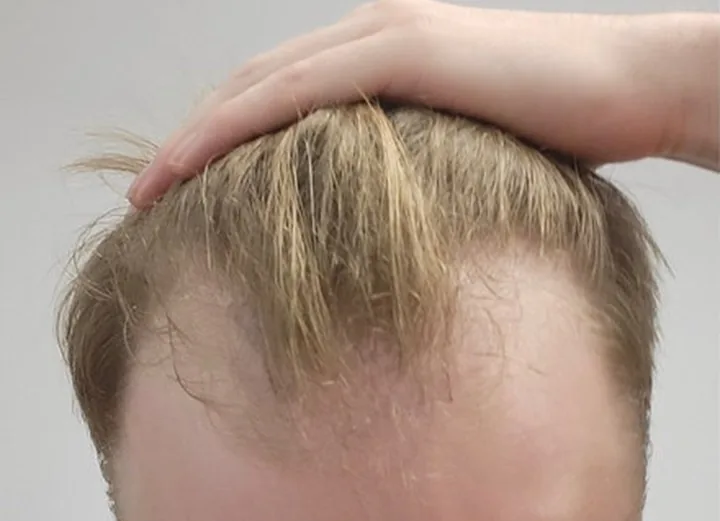
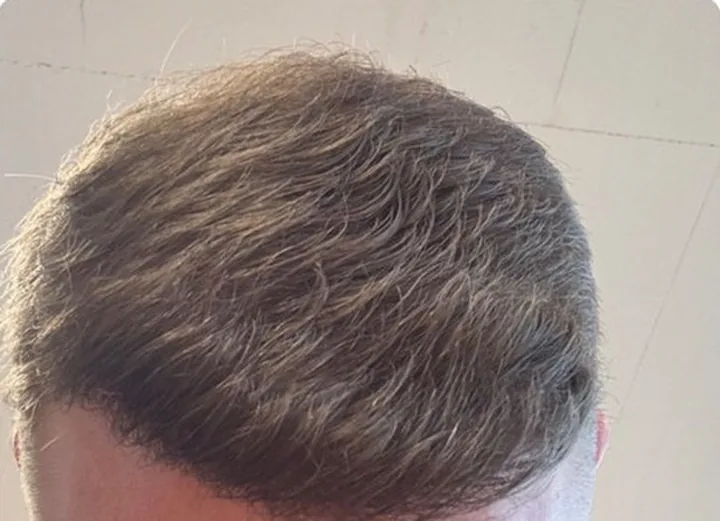
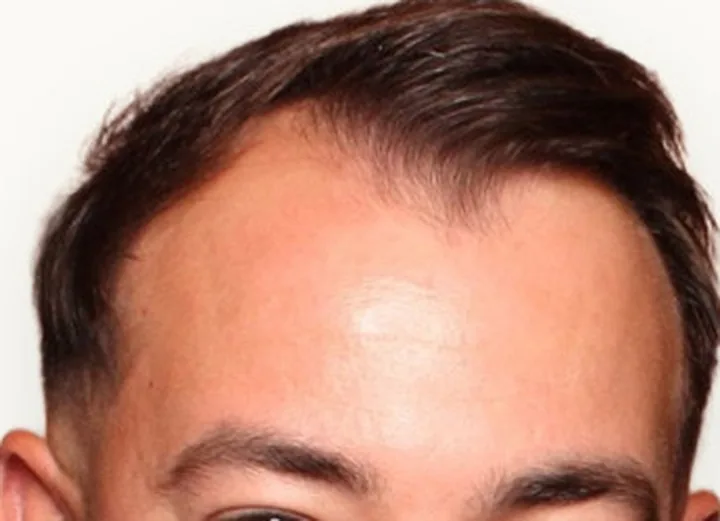
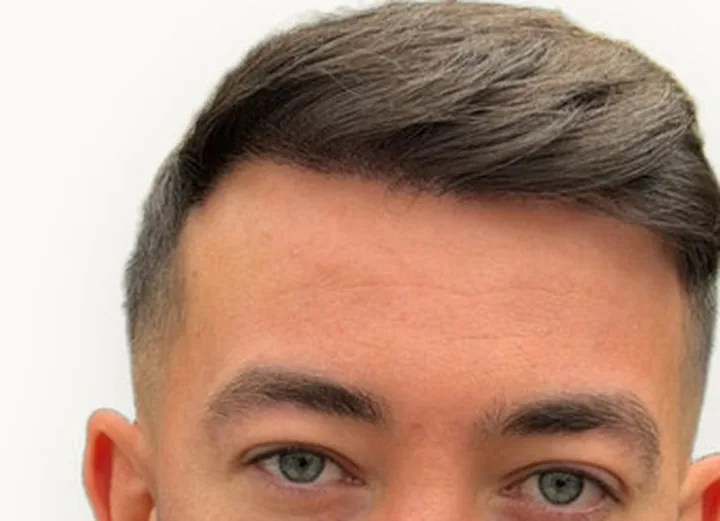
Why is there a difference of 1’300 grafts? In both cases, the hairline and receding temples were treated:
- With 1’500 grafts: There was still a lot of the patient’s own hair at the front; the main aim was to add density. The light hair also has little contrast with the scalp.
- With 2’800 grafts: The hairline sat much higher, and the area to be filled was larger.
Case 2: front and top of the scalp, 4’250 grafts
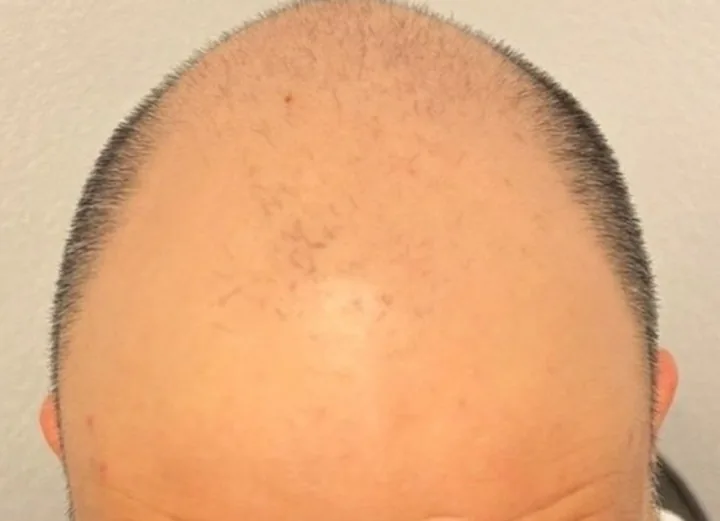
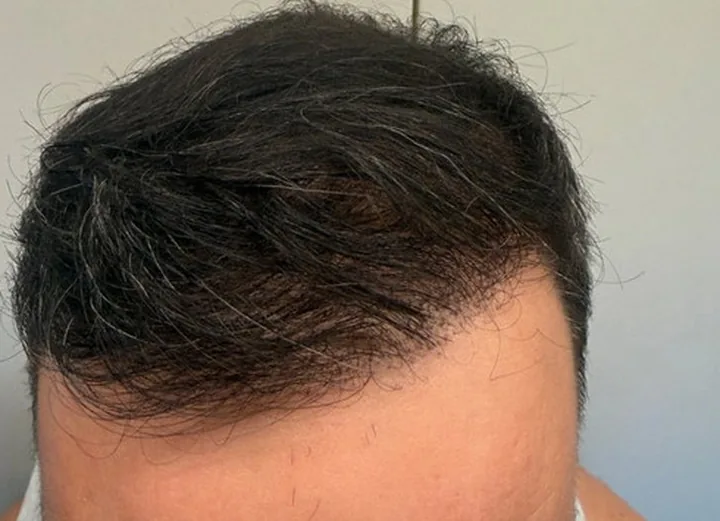
Why around 4’250 grafts?
- Starting point: advanced hair loss at the front and on the top of the scalp.
- Area: large, from the hairline far into the top of the scalp.
- Goal: a new frame for the face and coverage of the top of the scalp.
Case 3: woman, thinning hair at the front, 1’000 grafts
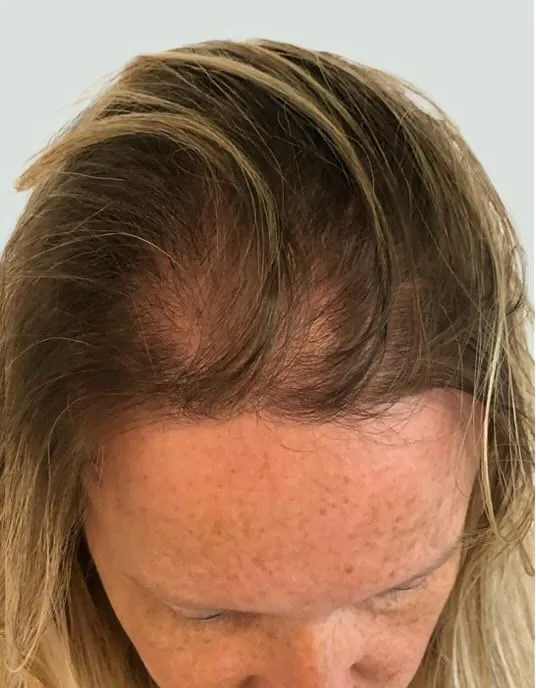
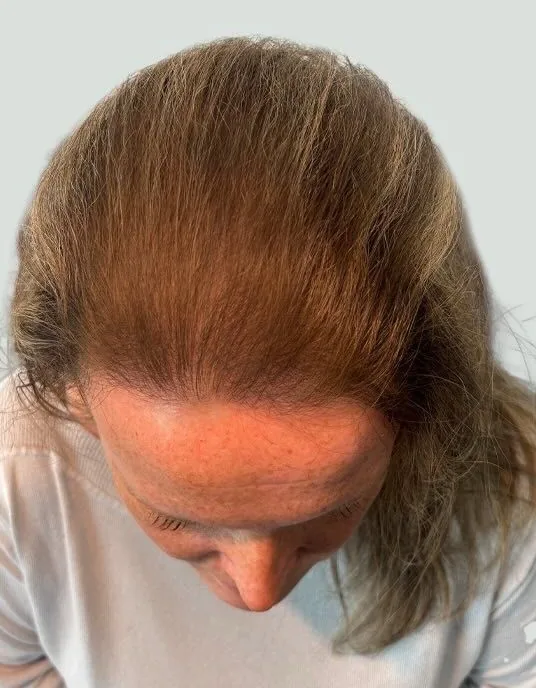
Why around 1’000 grafts?
- Starting point: thinning hair at the front and along the front of the parting, with the hairline itself preserved.
- Area: the front area, not the whole head.
- Goal: more density at the front without placing too much demand on the donor area.
How much does a hair transplant cost at Swiss Hair Life?
At Swiss Hair Life you pay a fixed price per graft tier, not a price per graft. Consultation, procedure, aftercare and all follow-up appointments are included.
You can find our current fixed prices on the page hair transplant: prices.
Price and number of grafts are not the same. The tier “1’501 to 2’800 grafts” does not mean that 2’800 grafts will be transplanted for you. We only use as many grafts as make sense medically and aesthetically.
You can find more about our services and payment in instalments on the page hair transplant in Switzerland.
How we determine your number of grafts
- Look at the starting point: from your photos or during the consultation on site.
- Assess the hair loss pattern: Where is the hair thinning, and how far has the hair loss progressed?
- Assess the donor area: density, hair thickness and grafts with one, two or more hairs.
- Discuss the goal: desired hairline and density.
- Take the long-term course into account: possible further hair loss and reserve for later.
- Plan a realistic number of grafts: the number that suits your goal and your donor area.
Photos help even before the consultation. The precise assessment takes place during the free consultation in Zurich or Oftringen.
Frequently asked questions about grafts
What is a graft?
A follicular unit, a natural group of usually one to four hairs. A graft is therefore not the same as a single hair.
How many grafts do I need for receding temples?
For mild receding temples, often up to around 1’500 grafts; for deep temples, more likely 1’500 to 2’800. More on this in the section on receding temples.
Are more grafts automatically better?
No. What matters is distribution, angle, direction and planning that leaves reserves for later.
How many grafts can be transplanted in one session?
At Swiss Hair Life, treatments of up to 3’800 grafts are usually planned in one session. Larger treatments of up to 6’000 grafts can be split over two sessions.
How accurate is a graft calculator?
A calculator only gives a rough guide. It knows neither your donor area nor your hair structure in detail. The number that actually makes sense can only be determined after an examination.
How do I find out my exact number of grafts?
With the free hair analysis: you send us photos and we give you an initial assessment. We set the exact number during the consultation, after examining your donor area.
Sources
- Headington JT. Transverse microscopic anatomy of the human scalp. Arch Dermatol. 1984;120(4):449–456.
- Bernstein RM, Rassman WR. Follicular transplantation. Patient evaluation and surgical planning. Dermatol Surg. 1997;23(9):771–784.
- Bernstein RM, Rassman WR. The aesthetics of follicular transplantation. Dermatol Surg. 1997;23(9):785–799.
- Jimenez F, Ruifernández JM. Distribution of human hair in follicular units. A mathematical model for estimating the donor size in follicular unit transplantation. Dermatol Surg. 1999;25(4):294–298.
- Rassman WR, Bernstein RM, McClellan R, et al. Follicular unit extraction: minimally invasive surgery for hair transplantation. Dermatol Surg. 2002;28(8):720–728.
- Orentreich N. Autografts in alopecias and other selected dermatological conditions. Ann N Y Acad Sci. 1959;83:463–479.
- Norwood OT. Male pattern baldness: classification and incidence. South Med J. 1975;68(11):1359–1365.
- Ludwig E. Classification of the types of androgenetic alopecia (common baldness) occurring in the female sex. Br J Dermatol. 1977;97(3):247–254.
- Complications in follicular unit excision hair transplantation: current evidence and practical approaches. Front Med. 2026.
- International Society of Hair Restoration Surgery (ISHRS). FUE Guidelines. 2019.
- International Society of Hair Restoration Surgery (ISHRS). A Guide to Hair Transplant for Women.
- Swiss Hair Life: graft tiers and fixed prices, and documented treatment results, as of November 2026.
How many grafts are realistic for you?
Upload photos from the front, from above and of your donor area. Our team in Zurich and Oftringen will give you a free initial assessment.