
Hair Transplant Recovery: Day by Day
Published Content: Swiss Hair Life editorial team
Medically reviewed by Dr. Sabrina Tahery (Medical Lead Oftringen) and Dr. Moustafa Kassar (Medical Lead Zurich) · Medically updated
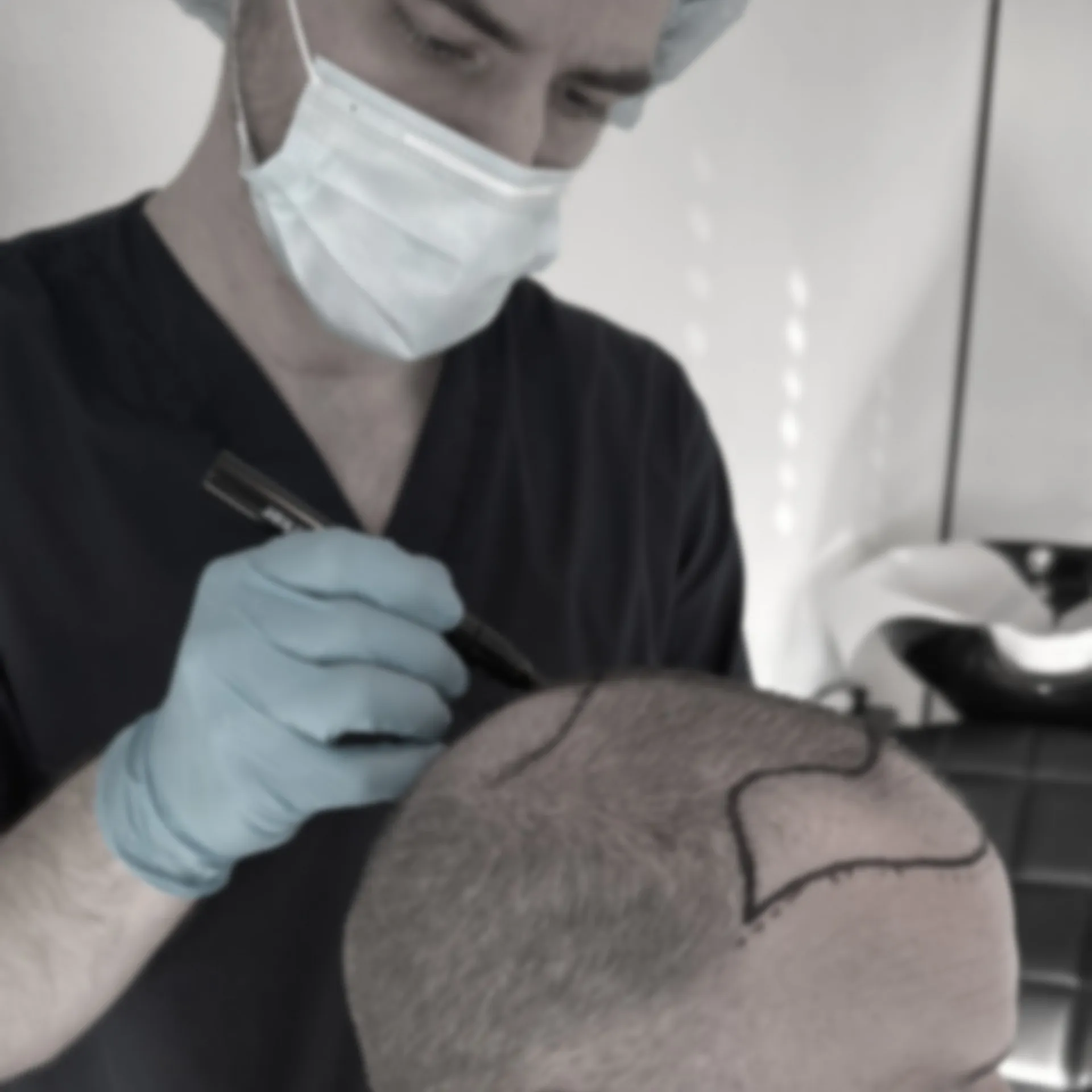
What happens after the procedure? When can you wash your hair, sleep normally again or exercise, and when does the new hair grow? We take you through the recovery from the day of treatment to the final result, just as we guide it at Swiss Hair Life in Zurich and Oftringen.
Short answer: The first visible healing phase is usually complete after 5 to 7 days. Redness, mild swelling and small scabs are common in the first few days; swelling and scabs usually subside within one to two weeks, while mild redness can remain visible for longer. In the following weeks, the transplanted hair shafts often fall out temporarily. After 3 to 4 months the new hair starts to grow, after 6 to 9 months the difference is usually clearly visible, and for many patients the result can be assessed after about 12 to 18 months.
Key points
- The first few days are especially important for protecting the freshly implanted grafts.
- Redness, swelling and scabs are part of the normal early healing phase.
- We carry out the first hair wash and remove the bandage personally at the clinic.
- The transplanted hair shafts often fall out temporarily in the first few weeks; the hair roots remain.
- The first new hairs usually grow after 3 to 4 months, fine at first.
- Density and length increase over many months.
- For many people, the final result can be assessed after about 12 to 18 months.
Contents
- Recovery day by day
- What is typical, and when?
- What can I do again, and when?
- Scabs, swelling, itching and redness
- When does transplanted hair grow?
- When should you contact us?
- How we support you
- Frequently asked questions
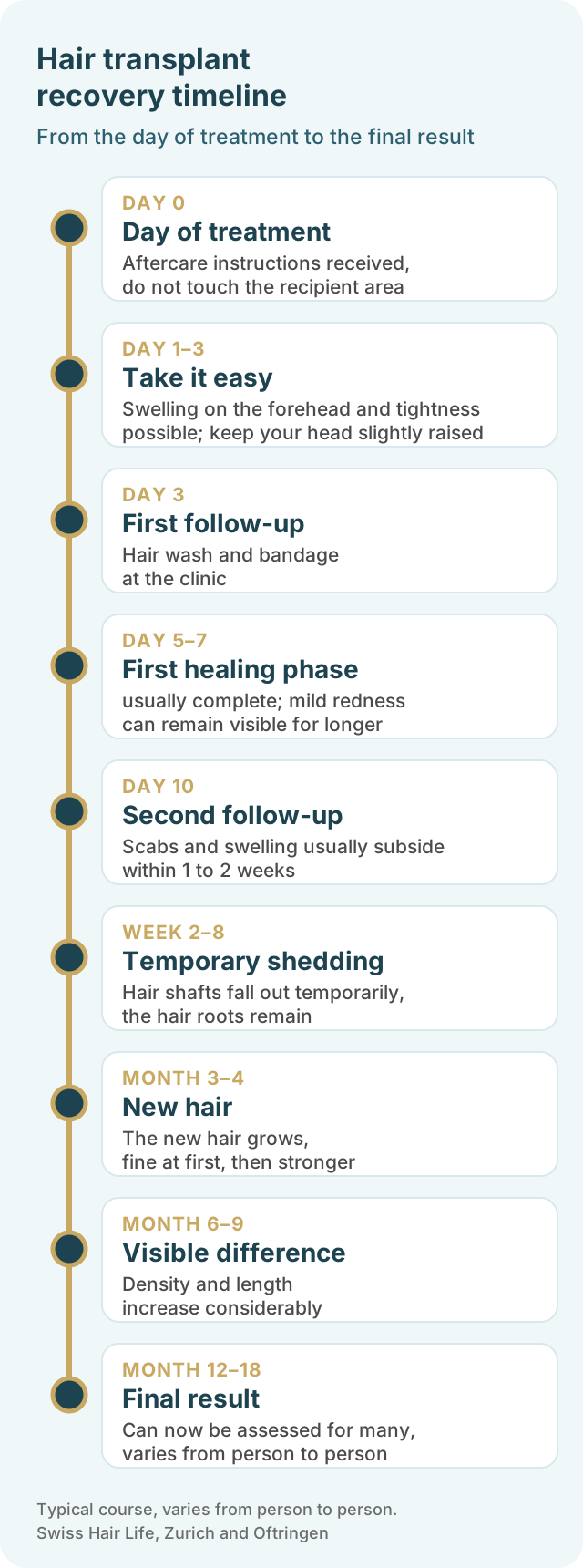
Recovery day by day
Everyone heals a little differently. The following steps show the typical course. What always counts for you is your personal aftercare instructions.
Day of treatment
After the procedure, the recipient area with the new grafts and the donor area at the back of the head are easy to see: small puncture marks, slight redness and, in the donor area, the closely shaved patches where the grafts were extracted. You receive your personal aftercare instructions and arrange your first follow-up appointments.
Important on the first evening: do not touch or scratch the recipient area, and do not knock it against anything. The freshly implanted grafts are not yet firmly in place; if a graft is pulled out during this time, no hair can grow in that spot any more.
Days 1 to 3: take it easy
Mild swelling on the forehead and a feeling of tightness are possible. Sleep with your head slightly raised. Allow yourself to rest and avoid physical exertion.
Day 3: first follow-up appointment and hair wash at the clinic
On day 3 you come to see us for your first follow-up appointment. We carry out the first hair wash and remove the bandage personally so that the grafts are not damaged. At the same time, you see how to wash your hair gently yourself over the following days.
Days 4 to 10: the scabs come away
The small scabs come away when you wash your hair following our instructions. Mild itching is common in this phase; do not scratch, and do not pick scabs off with your fingernails. The first healing phase is usually complete after 5 to 7 days.
Day 10: second follow-up appointment
On day 10 we see you for your second follow-up appointment. By then, swelling and scabs have usually gone down considerably; they generally subside within one to two weeks. Mild redness may remain visible for longer. Everyday life gradually returns to normal, even though the treated scalp still needs to be handled gently.
Weeks 2 to 8: temporary shedding
The visible shafts of the transplanted hairs often fall out at first. The hair roots stay in the skin and later form new hairs. Existing hair in the treated area can also fall out temporarily (shock loss); in most cases it grows back. Find out more in the article Can transplanted hair fall out again?
Months 1 to 3: patience
Not much is often visible in this phase. The hair roots are in a resting phase before they form new hairs. This is normal and not a sign of a poor result.
Months 3 to 4: the first new hairs
The new hairs begin to grow, fine at first, then stronger. They do not grow everywhere at the same time.
Month 6: clearer progress
For many people, the difference becomes clearly visible. However, density is not yet final, and progress varies from person to person.
Month 9: further thickening
Density and length increase considerably, and the hair gains texture. Development is often not yet complete.
Months 12 to 18: final result
For many patients, the final result can now be assessed. Some areas, such as the crown, sometimes take longer. Individual progress can vary.
What is typical, and when?
| Period | What may be visible? | What matters? |
|---|---|---|
| Days 0 to 3 | Redness, swelling on the forehead, feeling of tightness | Protect the grafts, keep your head slightly raised |
| Day 3 | First hair wash at the clinic | Follow-up appointment with us |
| Days 4 to 10 | Small scabs, itching | Follow the care instructions, do not scratch |
| Days 10 to 14 | Scabs and swelling usually gone | Second follow-up appointment on day 10 |
| Weeks 2 to 8 | Temporary shedding of the hair shafts | Patience, the hair roots remain |
| Months 1 to 3 | Little visible growth | Normal course |
| Months 3 to 4 | First new hairs, fine at first | Development begins |
| Months 6 to 9 | Clear difference | Keep an eye on progress |
| Months 12 to 18 | Well-developed result | Final assessment |
When can I do what again after a hair transplant?
The most important questions at a glance. Where the exact timing depends on your procedure, we give it to you in your personal aftercare instructions.
When can I wash my hair?
We carry out the first hair wash on day 3 at the clinic. After that you wash your hair yourself, gently and following our instructions: lukewarm water, the recommended mild product, no rubbing and no strong jet of water on the recipient area.
How long do I need to sleep with my head raised?
For the first few days you sleep with your head slightly raised. This can reduce swelling on the forehead and stops the recipient area from touching the pillow.
When can I sleep on my side again?
As soon as the recipient area can no longer rub against the pillow, that is, once the first healing phase is complete and we give you the go-ahead at your follow-up appointment.
When can I exercise again?
Light activity such as walking is usually possible again quite soon. You should pause strenuous exercise for a few weeks, because sweating, pressure and raised blood pressure put strain on the fresh scalp.
When can I do strength training again?
Strength training is one of the strenuous forms of exercise: straining while holding your breath and physical effort increase the pressure in your head. Only start once we have given you the go-ahead, and begin with light weights.
When can I wear a hat or cap?
Only once pressure and friction on the recipient area no longer put the grafts at risk. A loose-fitting hat is possible earlier than a tight-fitting one.
When can I wear a helmet again?
A helmet, for example for cycling, riding a motorbike or on a building site, presses firmly on the scalp. Allow more time for this than for a loose hat, and agree the timing with us at your follow-up appointment.
When can I go to the hairdresser again?
In the donor area, the shaved hair grows back quickly and can be trimmed earlier than the hair in the recipient area. A careful cut with scissors is possible earlier than clippers directly on the scalp.
When can I cut my hair?
You can carefully trim the hair around the recipient area with scissors as soon as the scalp has healed. Only cut the recipient area itself once we have given you the go-ahead.
When can I dye my hair?
Hair dyes contain substances that can irritate the freshly healed scalp. Only dye your hair once the scalp has fully healed and we have given you the go-ahead.
When can I use a sauna again?
Heat and heavy sweating put strain on the fresh scalp. Avoid saunas and steam rooms in the early healing phase. Your aftercare instructions tell you when you can use them again.
When can I go swimming?
In swimming pools, chlorine puts strain on the scalp; in the sea, lakes and rivers there is also a risk of infection from germs. Only go swimming once the scalp has fully healed and we have given you the go-ahead.
When can I go out in the sun again?
Protect the treated scalp from direct sunlight. Fresh skin is more sensitive to UV radiation, and sunburn disrupts healing. Only wear a head covering in the way your aftercare instructions allow.
When can I drink alcohol?
Before a hair transplant, please avoid alcohol and nicotine; only stop blood-thinning medication after consulting your doctor. Alcohol can increase bleeding and swelling, so avoid it in the first few days afterwards as well.
Smoking after a hair transplant
Nicotine narrows the blood vessels and can impair blood flow to the scalp, and therefore wound healing. The longer you can go without it before and after the procedure, the better for healing.
When can I fly after a hair transplant?
This is individual and depends on swelling and on your follow-up appointments. What matters is that you can attend the follow-up appointments on day 3 and day 10. At Swiss Hair Life they take place in Zurich or Oftringen, with no travel involved. What to look out for with treatment abroad is explained in the article Hair transplant in Switzerland vs. Turkey.
Minoxidil after a hair transplant
At Swiss Hair Life, you start using minoxidil again no earlier than two weeks after the procedure, once the scalp has healed. Find out more in the article Minoxidil before and after a hair transplant.
Scabs after a hair transplant: what is normal?
Scabs form because a little blood and wound fluid dries at each puncture site. They are part of normal healing and gradually come away when you wash your hair following our instructions.
- Do not scratch them or pick them off with your fingernails: this can pull out grafts.
- Do not rub them vigorously or soak them unless your instructions say so.
- If in doubt, ask us.
When should the scabs be gone?
Swelling and scabs usually subside within one to two weeks. At the follow-up appointment on day 10 we look at how things are going together.
Swelling after a hair transplant
Because of the anaesthetic and the fluid used during the procedure, swelling can develop on the forehead in the first few days, sometimes moving down towards the eyes. It is usually harmless and goes down on its own. Sleeping with your head slightly raised and taking it easy help. If the swelling increases instead of decreasing after a few days, or if pain or fever develops, get in touch with us.
Is itching normal after a hair transplant?
Yes. Itching is a common sign of healing, especially when the scabs are coming away. Do not scratch. If the itching becomes severe, ask us what you can do.
How long does the scalp stay red?
That varies and depends, among other things, on your skin type. Mild redness in the recipient area can remain visible for longer than scabs and swelling, often for a few weeks. On fair skin, redness is usually more noticeable.
What is shock loss?
Shock loss is the temporary shedding of your own hair around the treated area after the procedure. This hair usually grows back. We explain this in detail, together with the question of how permanent transplanted hair is, in the article Can transplanted hair fall out again?
When does transplanted hair grow?
The new hair grows gradually. Progress is individual; this overview shows what is typical for many patients:
- Month 1: The transplanted hair shafts have often fallen out; the hair roots are resting.
- Month 2: Not much is usually visible.
- Month 3: The first fine hairs may become visible.
- Month 4: More new hairs, fine at first.
- Month 6: For many people, the difference is clearly visible.
- Month 9: Density and length increase considerably.
- Month 12: The result is well developed.
- Month 18: Final assessment, including areas that take longer.
You can see results of Swiss Hair Life patients on our hair transplant page.
When should you contact Swiss Hair Life?
Get in touch with us if:
- the pain increases rather than decreases after the first few days,
- the scalp is very red, hot or increasingly swollen,
- pus or cloudy fluid is coming out,
- you develop a fever,
- bleeding does not stop after a few minutes of gentle pressure with a clean compress,
- grafts have fallen out with bleeding,
- you are unsure whether your recovery is normal.
If in doubt, it is better to call once too early than too late: you can reach us on +41 62 557 15 57.
How we support your recovery at Swiss Hair Life
- Personal aftercare instructions: you receive them on the day of treatment, with the timings for washing, exercise, sun and sauna.
- Hair wash at the clinic: we carry out the first hair wash and remove the bandage personally on day 3.
- Follow-up appointments on day 3 and day 10: and at any time in between if you wish, with no limit.
- Further follow-up appointments included: they accompany you through to the result and are included in the fixed price.
- Dedicated contacts: in Zurich and Oftringen, even weeks and months after the procedure.
- PRP as a complement: PRP (platelet-rich plasma) treatment can support the regeneration of the scalp and existing hair growth. We discuss whether it makes sense for you in the consultation.
Find out more about the process, planning and prices on our page Hair transplant at Swiss Hair Life.
Not sure how a hair transplant would go for you? Have your hair loss and your donor area assessed free of charge. We will also explain what to expect after the procedure.
Frequently asked questions
When are transplanted grafts securely in place?
In the first few days the grafts are particularly delicate; they must not be touched, scratched or knocked. We discuss when you can treat your scalp normally again at the follow-up appointments on day 3 and day 10.
When can I sleep normally again?
Once the first healing phase is complete and we give you the go-ahead at your follow-up appointment. For the first few days you sleep with your head slightly raised.
When can I wash my hair after a hair transplant?
We carry out the first hair wash on day 3 at the clinic. After that you wash your hair gently following our instructions.
When can I start exercising again?
Light activity is usually possible again quite soon. You should pause strenuous exercise for a few weeks; your aftercare instructions give the exact timing.
How long do scabs remain visible?
Swelling and scabs usually subside within one to two weeks. Mild redness can remain visible for longer.
Is it normal for transplanted hair to fall out?
Yes, in the first few weeks. The hair shafts often fall out temporarily; the hair roots remain and later form new hairs.
When will I see the first new hairs?
Usually after 3 to 4 months, fine at first, then stronger.
When is the final result visible?
For many patients after about 12 to 18 months. Individual progress can vary.
References
- Liu Y, et al. A scoping review on complications in modern hair transplantation: more than just splitting hairs. Aesthetic Plast Surg. 2024.
- Garg AK, Garg S. Complications of hair transplant procedures: causes and management. 2021.
- Swiss Hair Life aftercare protocol, Zurich and Oftringen (follow-up appointments, hair washing, schedule), as of November 2026.