
What is minoxidil? What to know before and after a hair transplant
Published Last updated Content: Swiss Hair Life editorial team
Medically reviewed by Dr. Sabrina Tahery (Medical Lead Oftringen) and Dr. Moustafa Kassar (Medical Lead Zurich) · Medically updated
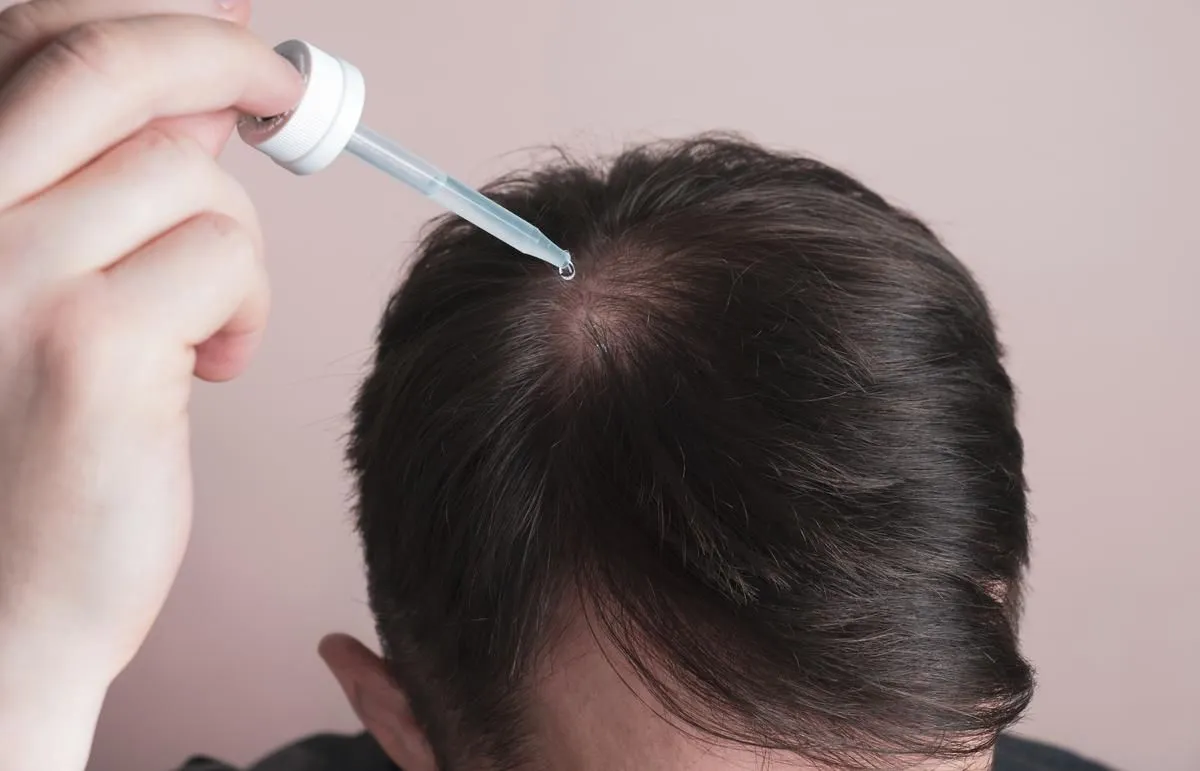
Minoxidil is the first active ingredient many people come across when they look for a solution to hair loss and thinning hair. It is found in hair loss solutions and foams. But what exactly is minoxidil, and what applies around a hair transplant?
Short answer: Minoxidil is an active ingredient applied to the scalp that can support hair growth in hereditary hair loss. Before a hair transplant at Swiss Hair Life, minoxidil is usually paused one week beforehand. Afterwards, you restart at the earliest two weeks after the procedure, once the scalp has healed. We agree the exact timing with you in each case.
Key points
- Minoxidil can support hair growth for as long as you use it. If you stop, the improvements gradually fade.
- Before the hair transplant: usually pause it one week beforehand, and only after talking to us.
- After the hair transplant: restart at the earliest after two weeks, once the scalp has healed.
- The first changes usually appear after a few months; at the start, you may temporarily shed more hair.
- Minoxidil is not used during pregnancy or breastfeeding.
Minoxidil is available without a prescription as a solution or foam for the scalp. It is applied directly where the hair is thinning.
At the heart of minoxidil’s effectiveness is its ability to widen the blood vessels in the scalp, which improves blood flow and the supply of nutrients to the hair follicles. Minoxidil also extends the growth phase of the hair. The concentration of the active ingredient in minoxidil formulations is usually between 2% and 5%.
How do you use minoxidil before and after a hair transplant?
| Timing | Recommendation at Swiss Hair Life |
|---|---|
| Before the procedure | Usually pause it one week beforehand. We set the exact timing in the preliminary consultation. |
| First two weeks afterwards | No minoxidil. The scalp is healing and the grafts are settling in. |
| From about two weeks onwards | Restart once the scalp has healed. We discuss the timing at the follow-up appointment. |
| Long term | We discuss with you whether minoxidil makes sense to protect your own hair. |
Using minoxidil before the hair transplant: at Swiss Hair Life, minoxidil is usually paused one week before the procedure. We set the exact timing in the preliminary consultation; please only stop any medication after talking to us.
Using minoxidil after the hair transplant: we recommend restarting minoxidil at the earliest two weeks after the procedure, once the scalp has healed. We discuss the exact timing at the follow-up appointment.
How healing progresses overall in the first weeks is explained in our guide Hair transplant recovery timeline.
Why this matters: a hair transplant does not stop hereditary hair loss. Your own, non-transplanted hair can continue to thin. Read more in the article Can transplanted hair fall out again?
How long should it be used?
Minoxidil only works for as long as you use it. Even if the results are not visible straight away, regular use over several months is often rewarded with noticeable improvements. Use the product as your doctor or the package leaflet recommends. A balanced diet, gentle hair care without excessive heat and a mindful approach to stress also help.
What are the side effects of minoxidil?
Before you use minoxidil, you should seek advice from a doctor or pharmacist. It is important to understand that while medications such as minoxidil can be useful, they can also cause side effects.
- Scalp irritation: Redness, itching or burning on the scalp where minoxidil is applied.
- Unwanted hair growth: Fine vellus hairs developing on unwanted areas of the body.
- Dry scalp: Possible dryness and flaking of the scalp.
- Increased shedding: Temporary hair loss before new growth begins.
- Irregular heartbeat: Rare cases of a rapid or irregular heartbeat.
- Dizziness: Occasional reports of dizziness or light-headedness.
- Allergic reactions: Rare allergic skin reactions, such as a rash, hives or swelling.
Minoxidil is not used during pregnancy or breastfeeding. If you have a cardiovascular condition, talk to your doctor first.
The difference between minoxidil and minoxidil 5%
- Minoxidil: This term refers to the active ingredient used to treat hair loss. Minoxidil is available in various formulations and concentrations, most often 2% or 5%. It is a solution or foam applied directly to the scalp to stimulate hair growth.
- Minoxidil 5%: This refers to a formulation with a concentration of 5%. It is usually recommended for men with hereditary hair loss.
For women, both 2% and 5% are used. Which concentration is right for you should be clarified with a doctor before you start.
Minoxidil tablets
Minoxidil is also available as a low-dose tablet. This form is prescription-only and is used only after a medical assessment and under medical supervision, for example if the scalp application is not tolerated. Studies show that low-dose oral minoxidil is effective in healthy patients and usually well tolerated. Never take it without a prescription.
Minoxidil and finasteride
Finasteride is a prescription medication for men with hereditary hair loss. The European S3 guideline names topical minoxidil for women and men, and finasteride for men, as effective medications. Whether a combination makes sense for you is for your doctor to decide.
How long does it take for minoxidil to work?
Although results can vary, you can generally expect to see some improvement from minoxidil within two to four months, with clear results after a full year of consistent treatment.
Short-term effects (first few weeks)
In the first few weeks of using minoxidil, you may not notice any significant change in hair growth. Some people, however, may experience a temporary increase in hair shedding. This shedding is often a sign that the hair follicles are entering a new growth phase.
Medium-term effects (around 3–6 months)
After around 3 to 6 months of consistent use, you may notice the first subtle improvements. Some people report finer, softer hair growth or a reduction in hair loss. This is a sign that minoxidil is starting to act on the hair follicles and encouraging them to enter the growth phase.
Long-term effects (6 months and beyond)
After 6 months of continuous use, you are more likely to see noticeable results. Many people experience greater hair density, better coverage and thicker strands. It is important to note that the results appear gradually and can continue to improve with longer use.
Consistency is key
Consistency is crucial when using minoxidil. It is important that you apply the product as your doctor has recommended or as stated in the package leaflet. If you stop using minoxidil, the improvements you have achieved may gradually fade and your hair may return to its previous state.
Is minoxidil a long-term, permanent solution for hair loss?
Minoxidil is generally not regarded as a permanent solution for hair loss. It can help to slow down hair loss, encourage hair growth and improve the appearance of thinning hair. However, its effect depends on continued use.
For people with bald areas, a hair transplant can be an option. Hair follicles are moved from the donor area at the back of the head to where hair no longer grows. They usually continue to grow permanently. For thinning hair where hair follicles are still present, PRP hair treatment or micrografting may also be options.
Frequently asked questions
Do I have to stop minoxidil before my hair transplant?
At Swiss Hair Life, minoxidil is usually paused one week before the procedure. We set the exact timing in the preliminary consultation.
When can I use minoxidil again after my hair transplant?
At the earliest two weeks after the procedure, once the scalp has healed. We discuss the timing at the follow-up appointment.
Is it normal to lose more hair at the start?
Yes, this can happen in the first few weeks and is usually temporary.
What happens if I stop using minoxidil?
The improvements you have achieved gradually fade, and your hair may return to its previous state.
If you would like lasting results and are considering a hair transplant under the guidance of an experienced specialist, you are welcome to contact Swiss Hair Life for a free consultation. Get your free hair analysis
References
- Kanti V, Messenger A, Dobos G, et al. Evidence-based (S3) guideline for the treatment of androgenetic alopecia in women and in men – short version. J Eur Acad Dermatol Venereol. 2018;32(1):11–22.
- Randolph M, Tosti A. Oral minoxidil treatment for hair loss: a review of efficacy and safety. J Am Acad Dermatol. 2021;84(3):737–746.
- van Zuuren EJ, Fedorowicz Z, Schoones J. Interventions for female pattern hair loss. Cochrane Database Syst Rev. 2016.