
PRP hair treatment: a useful option for hair loss?
Published Last updated Content: Swiss Hair Life editorial team
Medically reviewed by Dr. Sabrina Tahery (Medical Lead Oftringen) and Dr. Moustafa Kassar (Medical Lead Zurich) · Medically updated
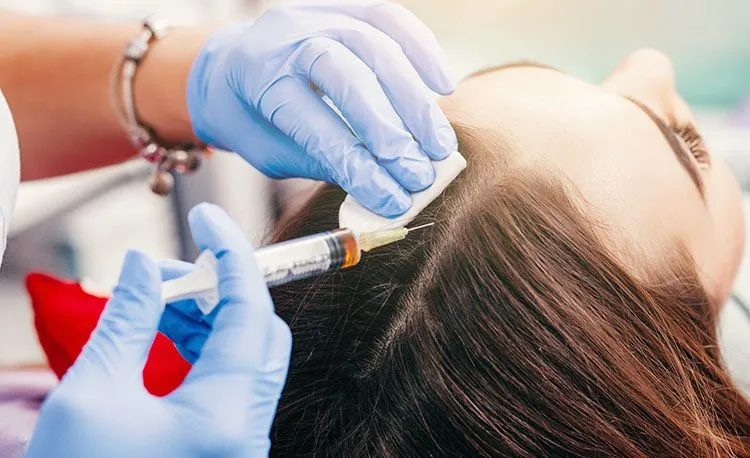
PRP (platelet-rich plasma) treatment is a non-surgical method that uses your body’s natural healing power to support hair growth. A small amount of your blood is taken and processed so that growth factors and proteins are present in concentrated form. This prepared solution is injected into the scalp to stimulate the hair follicles and support hair growth. PRP hair treatment is minimally invasive and, in suitable patients, can improve the density and strength of the hair. It does not create new hair follicles.
Short answer: Yes, for the right patients. Studies on hereditary hair loss show, on average, an increase in hair density after several treatments. PRP is mainly suitable for thinning hair without bald areas, usually needs at least four sessions and works for several months to about a year. PRP does not grow new hair on bald areas; there, a hair transplant is usually the more suitable option.
Key points
- PRP uses growth factors from your own platelets.
- It can support existing hair follicles but does not create new ones.
- As a rule, at least four sessions 4 to 6 weeks apart are advisable.
- The first changes often become visible after about 6 to 8 weeks.
- The effect lasts several months to about a year; after that, top-up sessions can be useful.
PRP hair treatment in Switzerland: costs
If you are considering a treatment with platelet-rich plasma (PRP) for hair loss, the question of costs in Switzerland often comes up. Prices can vary depending on the clinic and the number of sessions.
At Swiss Hair Life, fixed prices apply: one session costs CHF 550.–, 4 sessions CHF 2,000.– and 8 sessions CHF 3,500.–. We discuss how many sessions make sense for you after the free hair analysis.
PRP hair treatment prices and procedure in detail
How does PRP hair treatment work?
PRP hair treatment is a non-surgical approach that uses the body’s own healing mechanisms to support the hair follicles.
- Blood sampling: PRP treatment for hair loss starts with taking the patient’s own blood. In this first phase, 10 to 20 millilitres of blood are taken.
- Separating the red blood cells: In a centrifuge, the platelets are separated from the red blood cells.
- Obtaining the platelet-rich plasma: The result is a concentrate with a high concentration of platelets and their growth factors.
- Application: The platelet-rich plasma is injected with fine needles into the scalp where the hair is thinning.
- A short procedure: A session takes about 30 minutes. Most people find the injections easy to tolerate.
- After the treatment: The effect builds up over several sessions. How quickly and how clearly varies from person to person.
How good is the evidence?
Several systematic reviews and meta-analyses of randomised trials show, on average, an increase in hair density after several PRP treatments for hereditary hair loss. How strong the effect is differs from person to person. The studies use different preparation methods and treatment schedules, so their results can only be compared to a limited extent. You will find the most important studies below under “References”.
Does PRP hair treatment really make hair grow back permanently?
The effect of PRP hair treatment usually lasts several months to about a year, not permanently. Building it up takes several sessions; depending on progress, top-up sessions at longer intervals can be useful later on. The treatment can support existing hair follicles but does not create new ones.
Who is PRP suitable for?
PRP is an option if you still have enough of your own hair follicles that can be strengthened.
PRP may be suitable for:
- thinning hair without bald areas,
- mild or diffuse hair loss,
- women with a widening parting,
- younger people for whom a transplant is still too early,
- support before and after a hair transplant.
A hair transplant is more likely to be the answer for bald areas such as receding temples or a bald crown, for advanced hair loss or a receding hairline. If hormonal or other medical causes are involved, for example a thyroid condition, a medical assessment comes first; read more in the guide Possible causes of hair loss.
What are the benefits of PRP hair treatment?
PRP hair treatment uses growth factors from your own platelets. It is non-surgical and usually involves only short downtime.
Benefits at a glance
- Support for hair loss: Can help to strengthen thinning hair.
- Existing hair follicles: Growth factors can support weakened but still present hair follicles.
- Scalp: Can support the regeneration of the scalp, including as an addition after a hair transplant.
- Your own material: Because your own blood is used, allergic reactions to the plasma are very unlikely.
PRP or micrografting?
Both treatments are minimally invasive and can support existing hair. They differ mainly in the starting material: PRP uses your blood and is usually given over several sessions, while micrografting uses hair follicle tissue and is usually carried out as a single treatment. Read more in the article Stem cells for hair loss? What micrografting can do.
What should you do before PRP hair treatment?
Before
- Consultation: Book an appointment to assess whether you are suitable. Our experts guide you through the whole process.
- Blood thinners: Check with your doctor whether any medication should be stopped. Do not stop anything on your own.
- Fluids: Drink enough in the days before the treatment and eat fairly low-fat food.
- Clean scalp: Wash your hair on the day of the treatment.
After
- Follow the aftercare advice: Stick to the recommendations of your medical team.
- Sun protection: Avoid direct sunlight.
- Hydration: Keep drinking enough water.
- Take it easy: Avoid strenuous activities for one to two days.
- Patience: The results develop over time. Stay consistent with your plan.
Side effects
Possible side effects are a feeling of tension or pressure during and shortly after the treatment, redness and slight swelling at the injection sites and, occasionally, small bruises that disappear after a few days. We advise against the treatment, for example, in the case of blood clotting disorders, certain blood thinners or acute infections.
How long does it take for hair to grow after PRP hair treatment?
The number of sessions needed and when hair growth appears depend on individual factors. As a rule, we recommend at least four sessions 4 to 6 weeks apart. In suitable patients, the first changes often become visible after about 6 to 8 weeks. An individual consultation is essential to set the best treatment plan.
Frequently asked questions
Does PRP work for everyone?
No. PRP is mainly suitable if you still have enough of your own hair follicles. For bald areas, a hair transplant is usually the more suitable option.
Can PRP replace a hair transplant?
No. PRP can support existing hair follicles but does not create new ones. The two can be combined.
Does PRP also help women?
Yes. PRP is used for women and men, for example for a widening parting. For women, we first clarify the cause of the hair loss.
How long does the effect last?
Usually several months to about a year. Depending on progress, top-up sessions at longer intervals can be useful.
Find out whether PRP hair treatment is an option for you in the free hair analysis.
References
- Platelet-rich plasma for androgenetic alopecia: a systematic review and meta-analysis of randomized controlled trials. J Cutan Med Surg. 2023.
- Systematic review of platelet-rich plasma in treating alopecia: focusing on efficacy, safety, and therapeutic durability. 2021.
- Gentile P, et al. The effect of platelet-rich plasma in hair regrowth: a randomized placebo-controlled trial. Stem Cells Transl Med. 2015;4(11):1317–23.
- Alves R, Grimalt R. Randomized placebo-controlled, double-blind, half-head study to assess the efficacy of platelet-rich plasma on the treatment of androgenetic alopecia. Dermatol Surg. 2016;42(4):491–7.
- Stevens J, Khetarpal S. Platelet-rich plasma for androgenetic alopecia: a review of the literature and proposed treatment protocol. Int J Womens Dermatol. 2019;5(1):46–51.
- Efficacy of platelet-rich plasma as an adjunct to hair transplantation: a systematic review. Cureus. 2025.