
Stem cells for hair loss? What micrografting can do
Published Last updated Content: Swiss Hair Life editorial team
Medically reviewed by Dr. Sabrina Tahery (Medical Lead Oftringen) and Dr. Moustafa Kassar (Medical Lead Zurich) · Medically updated
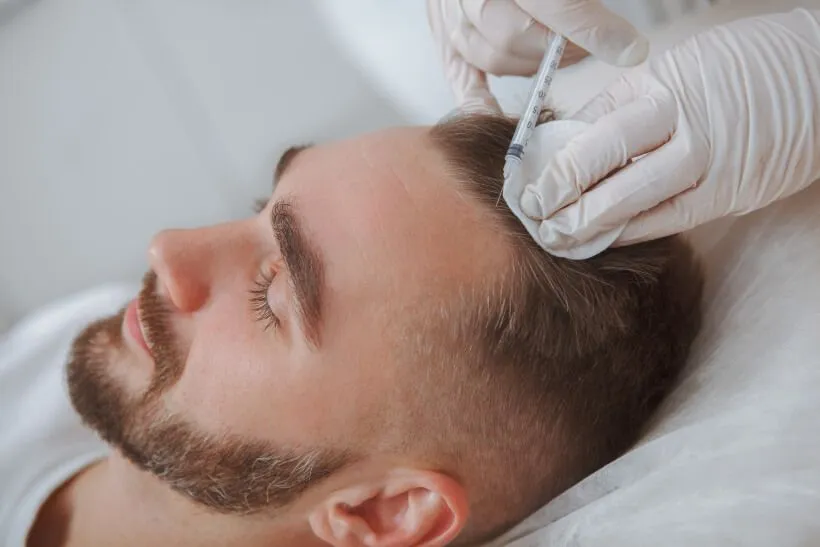
Micrografting is a treatment for thinning hair that uses your own hair follicle tissue. It is sometimes informally called a stem cell treatment for hair. In fact, no stem cells are isolated or grown in a laboratory: the prepared tissue may contain stem and progenitor cells, among other things, and is applied in the same session.
Short answer: Treatment with laboratory-grown stem cells for hair loss is not routine. What is known as “stem cell treatment for hair” is usually micrografting: three small tissue samples from behind the ear are prepared and, in the same session, introduced into the scalp where the hair is thinning. Early studies show promising results in hereditary hair loss, but the evidence is still limited.
Key points
- Micrografting uses your own hair follicle tissue; no stem cells are grown in a laboratory.
- It can support existing, weakened hair follicles but does not replace a hair transplant on bald areas.
- The first changes can often become visible after about 4 months.
- The treatment takes about 60 minutes under local anaesthetic and is usually carried out as a single treatment.
- At Swiss Hair Life, it costs CHF 2,500.– at a fixed price.
Below, we explain the procedure in four steps, what the treatment costs, who it is suitable for and how it differs from PRP hair treatment. You will find more details on our micrografting page.
What are stem cells in the hair follicle?
Every hair follicle contains its own stem cells. They ensure that the follicle can form a new hair after each resting phase. In hereditary hair loss, the hair follicles shrink over time and this renewal process slows down. This is where the idea behind micrografting comes in: cell components from healthy hair follicle tissue of your own are intended to stimulate weakened hair follicles.
How micrografting works for hair loss in 4 steps
Step 1: Consultation and assessment
Your journey begins with a consultation with our specialist. This expert takes the time to understand your individual situation. They will examine your scalp, discuss your medical history and assess the extent of your hair loss. Based on this assessment, the specialist can determine whether you are a suitable candidate for micrografting and tailor the treatment to your needs.
Step 2: Tissue collection
Under local anaesthetic, three very small skin samples are taken from behind the ear (diameter: 2.5 mm). The procedure is minimally invasive.
Step 3: Preparing and applying the tissue
After collection, the tissue is processed into a suspension in the same session using a special procedure. This is introduced with around 60 fine injections into the areas where the hair is thinning. The whole treatment takes about 60 minutes; afterwards, you can usually return to your daily routine straight away.
Step 4: Monitoring and gradual progress
After the treatment, patience is needed. The first changes can often become visible after about 4 months; individual progress may vary.
During this time, you will have regular follow-up appointments with our specialist. We document your progress with photos and the hair scan from the hair analysis.
Micrografting for hair: price
At Swiss Hair Life, micrografting costs CHF 2,500.– per treatment, at a fixed price. It is generally carried out as a single treatment; whether a repeat treatment may be useful later depends on your individual progress. The consultation and hair analysis beforehand are free of charge.
Micrografting for hair: results and evidence
Early clinical studies show promising results in hereditary hair loss, including an increase in hair density, in women and men. The studies are mostly small and short; the evidence is not yet as extensive as for established standard therapies and is still developing. Systematic reviews also conclude that further, larger studies are needed.
Micrografting can support existing, weakened hair follicles. However, it does not create new hair follicles on completely bald areas. You will find the individual studies below under “References”.
Am I suitable for micrografting?
Micrografting may be suitable for:
- thinning hair without bald areas,
- hereditary hair loss at an early stage,
- women and men,
- people who want a minimally invasive treatment without a hair transplant.
A hair transplant is more likely to be the answer for bald areas such as receding temples or a bald crown, for advanced hair loss or a receding hairline.
Also important:
- General health: Your overall physical condition must allow for treatment.
- Expectations: Realistic expectations are essential. This treatment can improve results but cannot work miracles.
If hormonal or other medical causes are involved, a medical assessment comes first; read more in the guide Possible causes of hair loss. A personal consultation at Swiss Hair Life in Zurich or Oftringen helps to clarify whether you are suitable.
The difference between micrografting and PRP hair treatment
Both methods rely on the body’s own material, but with different approaches:
- PRP hair treatment: Blood is taken and the platelet-rich plasma is injected into the scalp to promote hair growth, usually over several sessions.
- Micrografting: Three small tissue samples are taken from behind the ear, prepared and introduced into the scalp, usually in a single treatment.
| Micrografting | PRP hair treatment | |
|---|---|---|
| Starting material | Hair follicle tissue from behind the ear | Your own blood |
| Sessions | Usually one | Usually at least four |
| Price at Swiss Hair Life | CHF 2,500.– | CHF 550.– per session, packages from CHF 2,000.– |
| First changes | Often after about 4 months | Often after about 6 to 8 weeks |
Both procedures are minimally invasive. We inform you about possible side effects before the treatment. Which method suits you depends on the cause, the stage and the hair follicles still present; read more about PRP hair treatment.
How to recognise a reputable offer
There are many promises around “stem cells for hair loss”. Be careful if an offer:
- promises new hair on completely bald areas,
- guarantees a specific result,
- does not include a medical examination before the treatment,
- leaves it unclear where the material used comes from and how it is prepared.
Side effects
Micrografting is a minimally invasive treatment. Temporary redness, swelling and tenderness are possible, as are, occasionally, small bruises or scabs. At the collection site behind the ear, slight discomfort, minor bleeding or a small scar are possible; infection is rare. We advise against the treatment, for example, in the case of acute infections, certain blood clotting disorders or hair loss whose cause has not been clarified.
Frequently asked questions
Is there a stem cell therapy for hair loss?
Therapy with laboratory-grown stem cells is not routine. Micrografting uses prepared hair follicle tissue of your own, which may contain stem and progenitor cells, among other things.
Is micrografting a stem cell treatment?
Only in simplified terms. No stem cells are isolated or grown in a laboratory; the tissue is prepared and applied in the same session.
Can micrografting replace a hair transplant?
No. Micrografting can support existing hair follicles. Where hair no longer grows, a hair transplant is the more suitable option.
When will I see the first results?
The first changes can often become visible after about 4 months. Individual progress may vary.
How much does micrografting cost?
At Swiss Hair Life, CHF 2,500.– per treatment, at a fixed price. The consultation and hair analysis beforehand are free of charge. Get your free hair analysis
References
- Gentile P, et al. Autologous micrografts from scalp tissue: trichoscopic and long-term clinical evaluation in male and female androgenetic alopecia. Biomed Res Int. 2020.
- Gentile P, et al. Autologous cellular method using micrografts of human adipose tissue derived follicle stem cells in androgenic alopecia. Int J Mol Sci. 2019.
- Zari S. Short-term efficacy of autologous cellular micrografts in male and female androgenetic alopecia: a retrospective cohort study. Clin Cosmet Investig Dermatol. 2021;14:1725–36.
- Krefft-Trzciniecka K, et al. Short-term clinical assessment of treating female androgenetic alopecia with autologous stem cells derived from human hair follicles. Biomedicines. 2024;12(1):153.
- Krefft-Trzciniecka K, et al. Human stem cell use in androgenetic alopecia: a systematic review. Cells. 2023.
- Gasteratos K, et al. Autologous stem cell-derived therapies for androgenetic alopecia: a systematic review of randomized control trials. Plast Reconstr Surg Glob Open. 2024.